Critical boundary: this is an enforcement-record snapshot, not a gummy-industry recall rate. The API provides no denominator for the number of products manufactured or sold. It cannot support claims about market incidence, a named company’s overall quality or medical risk.
Why 25 report rows do not mean 25 independent recalls
The openFDA food enforcement API returns one record for each recall_number. A single event can cover several products, flavors, package sizes or consignee configurations and therefore appear as several report rows. In this result, one adjacent psychoactive-gummy event accounted for 11 report rows under a single event_id.
For buyer analysis, the independent unit is the event ID. We therefore retained the raw report count for auditability, grouped records by event ID, and then manually classified whether each event explicitly involved a supplement or functional-nutrition gummy. This avoids turning a multi-SKU event into a false pattern.
What appeared across the six included events
Three of the six distinct included events involved undeclared allergens. The remaining three involved foreign material, an undeclared active ingredient or labeling. Because the sample is only six events, the bars show observed counts—not prevalence estimates.
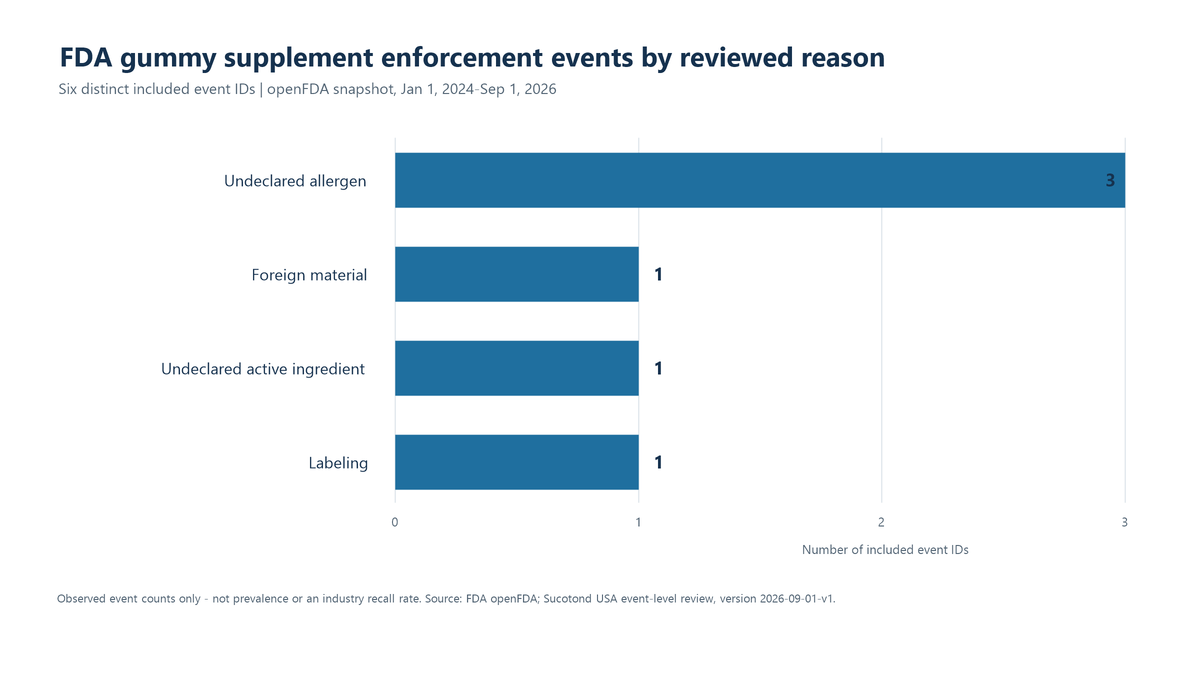
Use the high-resolution evidence chart.
The 2400 × 1350 PNG carries the sample boundary and source line for editorial or internal sourcing use. Keep the caption and do not reframe the six events as a market rate.
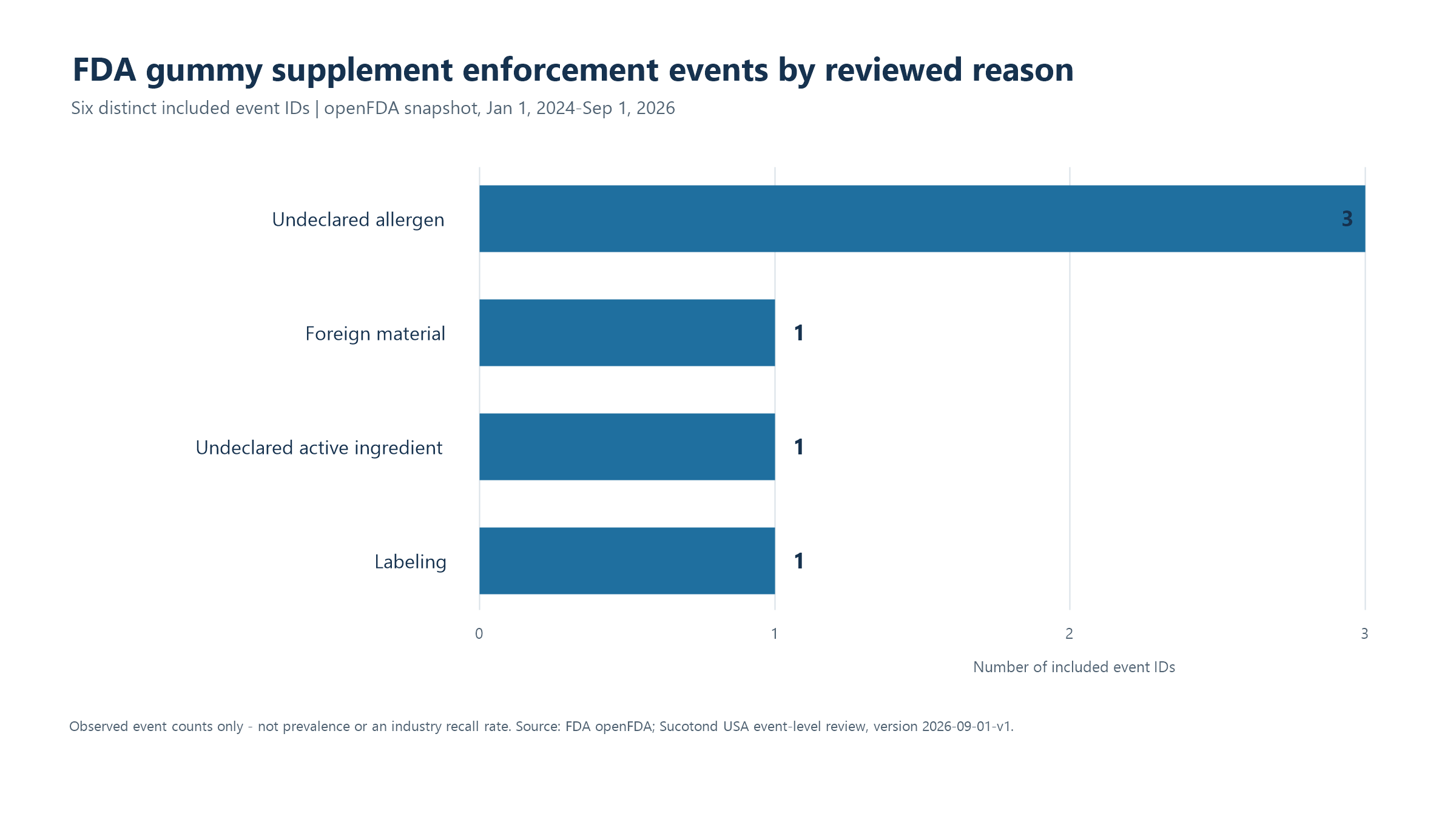
Embed this chart with its source boundary
<a href="https://sucotondusa.com/resources/fda-gummy-enforcement-data.html"><img src="https://sucotondusa.com/images/research/fda-gummy-enforcement-event-reasons-v1.png" alt="Counts by reviewed reason across six included FDA gummy supplement enforcement event IDs" width="1200" height="675"></a>
<p>Source: U.S. FDA openFDA; Sucotond USA event-level review 2026-09-01-v1. Six included events; observed counts, not prevalence or an industry recall rate.</p>Event-level audit table
Each row below is one distinct FDA event ID. “Report rows” preserves how many recall-number records the event generated. Status is the value in the September 1, 2026 snapshot and may change later.
| Date | Event | Class | Status | Recalling firm | Reviewed reason | Report rows |
|---|---|---|---|---|---|---|
| Jun 24, 2026 | 98984 | II | Ongoing | Dkiru LLC | Undeclared active ingredient | 1 |
| Oct 8, 2025 | 97084 | II | Completed | Vitalabs, Inc. | Undeclared allergen | 1 |
| Oct 1, 2025 | 97500 | II | Terminated | Extract Labs, Inc. | Undeclared allergen | 4 |
| Jul 9, 2025 | 97062 | I | Terminated | Vita Warehouse Corp. | Undeclared allergen | 1 |
| Jun 11, 2025 | 96689 | III | Terminated | Nordic Naturals, Inc. | Labeling | 1 |
| Mar 12, 2025 | 96225 | II | Terminated | Health and Happiness (H&H) LLC. | Foreign material | 1 |
Download the reviewed event-level dataset.
The CSV includes event ID, report date, classification, status, recalling firm, reason category, report-row count, recall numbers, FDA reason text, a product example and the exact query URL.
Audit the complete reproducible research pack.
The ZIP combines the event CSV, exact query and response hash, all ten event-level scope decisions, quality checks, chart, citation files, README and a hash-bound Data Package descriptor. It contains no customer, outreach or private formula data.
Four RFQ controls the observed events support
1. Allergen and cross-contact evidence
Ask the manufacturer to identify allergens handled at the site, ingredient and processing-aid sources, segregation controls, cleaning verification, supplier-change notification and the evidence used for finished-label declarations. A simple “allergen free” answer is less useful than a dated declaration tied to the formula and facility.
2. Formula–label–COA reconciliation
Before artwork approval, reconcile the master formula, Supplement Facts, ingredient statement, allergen statement, serving size and finished-product specification. Before release, confirm that the COA and batch records refer to the commercial lot and the intended analytical scope.
3. Foreign-material controls
Ask which controls apply after cooking, depositing, drying, coating and packaging; how equipment and utensils are inspected; which detection or exclusion steps exist; and how a possible foreign-material complaint is escalated. Child-directed products need particular care, but the correct control plan remains process- and product-specific.
4. Active-ingredient declaration and change control
Require each active ingredient, input source and target amount to be reconciled against label copy and the approved master manufacturing record. The label and artwork checklist and change-control checklist turn those comparisons into reviewable gates.
Reproducible methodology
- Query window: FDA food enforcement records dated January 1, 2024 through September 1, 2026.
- Retrieval rule:
product_description:gumm*, which matches description tokens beginning with “gumm.” - Completeness check: the API reported 25 total rows and 25 unique recall numbers were downloaded with a limit of 1,000.
- Event deduplication: report rows were grouped by
event_id, producing 10 distinct matched events. - Scope review: six events explicitly involving supplements or functional nutrition were included. One adjacent psychoactive-gummy event and three conventional candy or beverage events were excluded from supplement-focused findings.
- Reason review: the FDA reason text was assigned to one buyer-readable reason category per event. The downloadable CSV preserves the original reason wording.
Re-run the source query: open the exact openFDA API request.
Audit the frozen inputs: inspect the query and event-review source manifest, the data-quality result and the byte-and-hash inventory. These files expose what was retrieved, what was grouped, what was excluded and which labels are our analysis rather than FDA classifications.
Limitations
- Keyword retrieval may miss a relevant record whose product description does not contain a token beginning with “gumm.”
- Manual scope review is conservative and is visible in the method; classifications are analytical labels, not FDA product-category determinations.
- FDA enforcement records can be corrected, updated, completed or terminated after this snapshot.
- The data cannot establish causation beyond the FDA reason text, and it does not replace an event-specific quality, regulatory, safety, legal or medical review.
Version, citation and corrections
Dataset version: 2026-09-01-v1. This stable snapshot uses FDA food-enforcement records dated January 1, 2024 through September 1, 2026 and the exact query shown above.
Suggested citation: Sucotond USA. “FDA gummy recall data: what supplement buyers can and cannot infer.” Version 2026-09-01-v1, September 1, 2026. https://sucotondusa.com/resources/fda-gummy-enforcement-data.html. Data source: U.S. Food and Drug Administration, openFDA.
Import the citation without retyping it.
Download a metadata-only record for Zotero, EndNote, Mendeley or a bibliography manager. These files identify this Sucotond USA analysis and its source; they do not claim a DOI, journal publication, peer review or FDA endorsement.
Reuse boundary: openFDA states that its content and data are generally public domain and provided under CC0 unless otherwise noted, while some third-party material may remain restricted. See the openFDA Terms of Service. Event grouping is based on FDA event IDs; the supplement-scope decisions and buyer-readable reason categories are Sucotond USA analytical labels, not FDA classifications. This page does not assert a separate open license for those manual labels.
Corrections: report a possible row, event, scope or category error to info@sucotondusa.com. Include the FDA event ID and an issuer-controlled source. A verified correction will update the page, CSV and version history together.
| Version | Date | Change record |
|---|---|---|
| 2026-09-01-v1 | Sep 1, 2026 | Initial event-level snapshot: 25 report rows, 10 matched event IDs and 6 included supplement or functional-nutrition events. |
Primary sources
- openFDA Food Enforcement API documentation
- openFDA query syntax documentation
- openFDA terms and data-rights notice
- FDA recalls, market withdrawals and safety alerts
Related label landscape: enforcement records answer a different question from label-database records. Use the NIH DSLD on-market gummy-label snapshot to review product-type and declared matrix patterns without treating either dataset as market share or product-quality evidence.
Frequently asked
Does 25 FDA report rows mean 25 independent gummy recalls?
No. The exact query returned 25 unique recall-number rows across 10 event IDs. One adjacent psychoactive-gummy event generated 11 product report rows, so event-level deduplication is necessary.
Can this dataset calculate a gummy industry recall rate?
No. The enforcement API provides no denominator for the number of gummy products manufactured or sold. The data describe retrieved records only.
What should a buyer ask a gummy manufacturer?
Start with allergen and cross-contact declarations, formula-label-COA reconciliation, foreign-material controls, finished-product release evidence and written supplier-change notification. Use the 24-point supplier qualification checklist to record the answers.